
Product Knowledge & Guides
E-House Checklist: What's Inside the Cabin?
An e-house arrives factory-wired with switchgear, HVAC, ventilation and sensors. This checklist shows what belongs inside and what to verify before delivery.
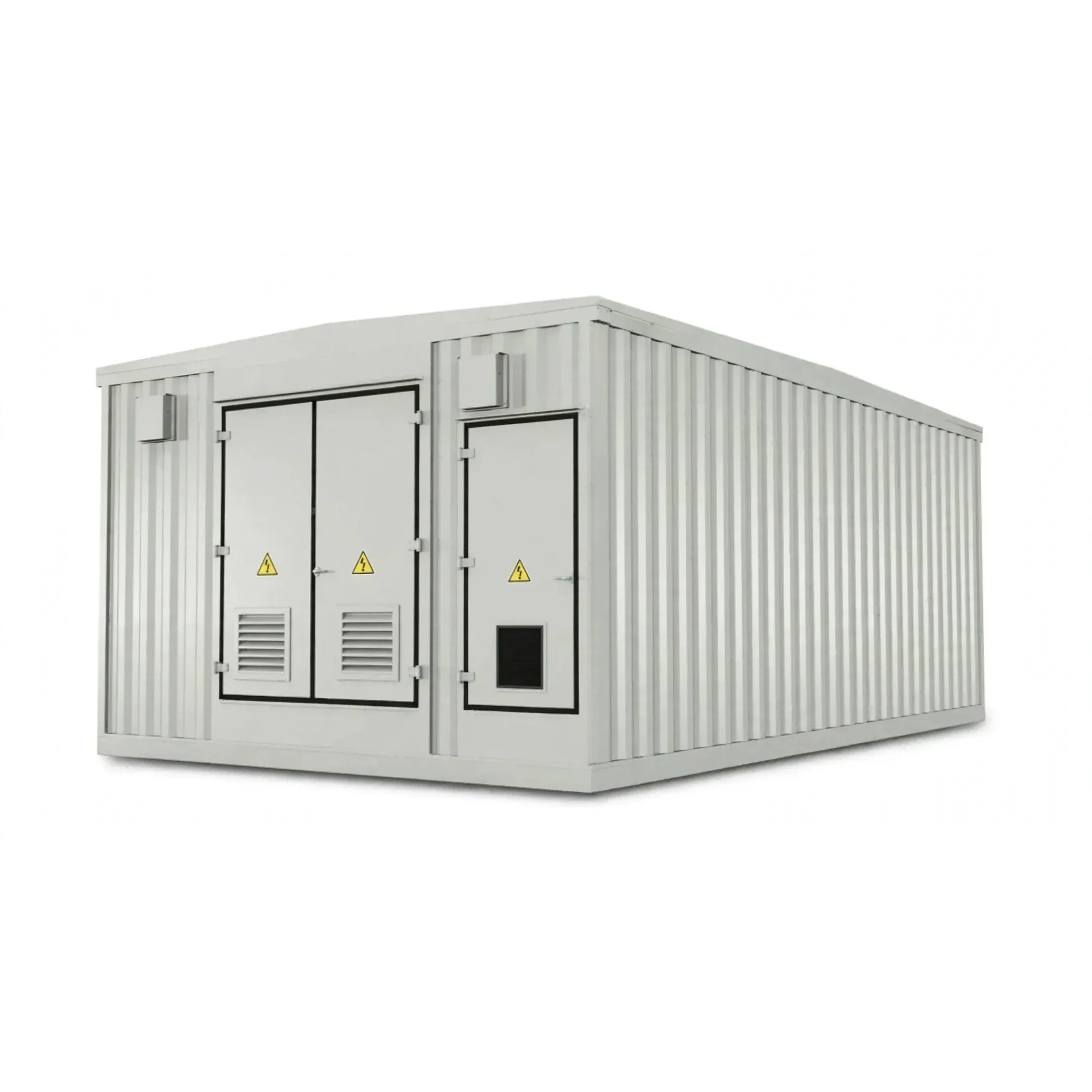
A prefabricated electrical equipment cabin — an e-house — is a factory-wired enclosure for primary and secondary electrical equipment, with HVAC, ventilation, sensors and grounding built in. This checklist explains what belongs inside, what to verify before delivery, and what a supplier needs to quote.
What is an e-house, and why are EPCs ordering them instead of building electrical rooms on site?
An e-house is a prefabricated electrical equipment cabin: a complete electrical room built in a factory, wired and tested there, then delivered to site as one unit. Inside it sits the equipment a substation or an industrial power system needs — switchgear, control cabinets and auxiliary equipment — with the climate control, ventilation, sensors and grounding already fitted. On site, the work is limited to placing the cabin, making the external connections and commissioning it.
The reason EPC contractors keep choosing this route is time. A site-built electrical room needs civil works, then equipment delivery, then installation, wiring and testing by different trades on a live site. An e-house moves most of that work into the factory, where it runs on a production line instead of a construction schedule. Industry reports put the site-work saving at 40 to 60 percent, and note that more than two thirds of new industrial power projects now use at least one prefabricated e-house. For remote sites, the case is stronger still: a mining operation may need three to six cabins, and building that many electrical rooms in the field, with labour and materials flown in, is slow and expensive.
Demand is also coming from two directions that did not exist at this scale a few years ago. Data centres need power infrastructure fast — hyperscale AI facilities cannot wait for a traditional substation build — and offshore wind projects need electrical modules that can be delivered and installed in a short weather window. The big manufacturers have responded in kind: Schneider expanded its e-house deployment in early 2026, ABB launched a compact prefabricated substation with digital monitoring in January 2026, and Eaton released e-house designs for renewable microgrids and offshore wind in late 2025. The market itself is growing steadily, with Grand View Research valuing e-houses at 1.8 billion dollars in 2025 and projecting 3.3 billion by 2033. An e-house is no longer a niche product. It is how a growing share of power infrastructure gets built.
What primary and secondary equipment goes inside the cabin?
The cabin is built around the equipment it will hold, so the layout follows the project, not the other way round. Primary equipment is the high-power side: the switchgear, transformers and distribution equipment that carry the load. Secondary equipment is the control side: protection relays, control cabinets, metering and the auxiliary systems that supervise the primary plant. Both live in the same enclosure, separated and arranged so that each can be reached, maintained and, if needed, replaced without disturbing the other.
That arrangement is the first thing to check in a supplier's proposal. A good cabin layout gives clear working clearances around the switchgear, keeps cable routes short and separate between power and control, and leaves room for the equipment the project will add later. A poor one packs everything tight to save steel and leaves the maintenance team working in a corridor. Ask for the layout drawing before you approve the order, and check three things on it: the clearances around each piece of equipment, the cable entry and exit points, and where a technician stands to work on each cabinet. If the drawing does not show those, the cabin is not ready to build.
The second thing to check is what the cabin is actually for. A prefabricated electrical equipment cabin suits substation projects, energy storage sites and industrial power distribution — anywhere primary and secondary equipment needs a ready-to-install home. It does not suit every electrical job: a small building's distribution board does not need a cabin, and a project with unusual equipment may need a custom enclosure rather than a standard one. A supplier that tells you that is doing you a favour. The cabin's strength is that it is a one-stop package — enclosure, equipment, wiring and built-in systems together — and that strength only holds when the equipment genuinely fits inside it.
How do HVAC, ventilation and sensors keep the equipment safe?
Electrical equipment fails when it gets too hot, too damp or too dirty, and a cabin's job is to keep all three under control. Air conditioning and fans in the primary and secondary cabins keep the running environment within limits, and the cabin forms a mechanical ventilation loop that circulates air through the enclosure. The fan ducts carry dust and water protection, so the ventilation that cools the equipment does not also bring in the dust and rain that damage it. These are not optional extras. They are part of the cabin, fitted in the factory, and they decide whether the equipment inside lasts its design life.
Sensors are the cabin's early warning system. Temperature and humidity sensors are fitted as standard, and their data is uploaded to the auxiliary control system, so an operator can see the cabin's condition without opening the door. Water immersion sensors can be added on request — worth asking for on any site where flooding is a risk, or where the cabin sits at grade. An inspection distribution box is fitted inside the cabin for maintenance power, so a technician working inside has power for tools and test equipment without running a cable from outside.
When you compare suppliers, compare these systems as a set, not as a list of line items. Ask what happens when one fan stops, whether the temperature sensors trigger an alarm or only a reading, and how the ventilation loop behaves if a duct is blocked. The answers tell you whether the cabin was designed as a system or assembled from parts. And remember that these systems are verified in the factory, not on site: the cabin and its internal equipment are wired in the factory before delivery, so the ventilation, sensors and grounding can be checked together, under power, before the cabin ever leaves the yard.
What should you check before the cabin leaves the factory?
Factory acceptance is the moment that saves the most money, because a fault found in the factory is a day's work and a fault found on site is a week's delay. Use this checklist before the cabin ships. First, the wiring: the cabin and its internal equipment are wired in the factory, so ask for the wiring test records and check that every circuit is labelled. Second, the grounding: protective grounding, lightning grounding and static grounding, plus anti-interference measures, are all part of the package — ask for the grounding test results and confirm the anti-interference measures are fitted, not just listed. Third, the sensors: confirm the temperature and humidity sensors report to the auxiliary control system, and that any water immersion sensors you ordered are fitted and tested.
Fourth, the ventilation: run the HVAC and the ventilation loop under power and confirm the air moves through the whole cabin, including the corners behind the cabinets. Fifth, the doors and seals: check the fan ducts' dust and water protection and confirm the cabin closes and seals properly — a cabin that leaks dust in the factory will leak dust on site. Sixth, the layout: walk the cabin against the layout drawing and confirm the clearances, cable routes and working positions you approved are actually there.
One more check belongs on every 2026 order, and it concerns the switchgear itself. From January 2026 the European Union bans SF6 gas in new medium voltage switchgear, and the industry is moving to vacuum and dry-air alternatives. If your project is in Europe, or if it follows European standards, confirm the switchgear in your cabin complies — do not assume a supplier's standard offering already does. A cabin that passes every factory test but fails a standards check on arrival is a cabin that has to come back.
What does a supplier need to quote your e-house?
A supplier needs three things to quote a cabin properly. First, the equipment to be housed: what primary and secondary equipment goes inside, with ratings and dimensions, so the layout and the enclosure size follow the equipment. Second, the site environment: where the cabin will sit, the climate it must handle, the ground conditions and any flooding or dust exposure, so the HVAC, ventilation and duct protection are specified correctly. Third, any standards the project must meet: electrical standards, safety standards and, for European projects, the SF6 rules above.
Send those three inputs and we confirm the cabin layout and configuration with you before production, then build it as a one-stop package — enclosure, equipment, HVAC, ventilation, sensors, grounding and factory wiring — and deliver it ready for on-site connection. If your project also needs battery storage alongside the electrical cabin, read our guide to the energy storage container, which explains how air-cooled and liquid-cooled BESS containers compare on lead time, cost and fire safety.
Frequently Asked Questions
What is an e-house?
An e-house is a prefabricated electrical equipment cabin: a factory-built enclosure that houses primary and secondary electrical equipment, with HVAC, ventilation, sensors and grounding built in. It arrives wired and tested, ready for on-site connection.
What equipment goes inside a prefabricated electrical equipment cabin?
Primary and secondary electrical equipment — switchgear, control cabinets and auxiliary equipment — wired and fitted in the factory. The layout is built around the equipment the project needs.
How is an e-house ventilated?
Air conditioning and fans keep the running environment within limits, and a mechanical ventilation loop circulates air through the cabin. Fan ducts have dust and water protection so ventilation does not bring in dust or rain.
Can water immersion sensors be added?
Yes. Temperature and humidity sensors are fitted as standard, with data uploaded to the auxiliary control system. Water immersion sensors can be added on request.
What information do you need to quote an e-house?
The equipment to be housed, the site environment, and any standards the project must meet. With those three inputs we confirm the cabin layout and configuration before production.
Ready to price your e-house? Send us the equipment to be housed, quantity and delivery location for a tailored quote.